 11
11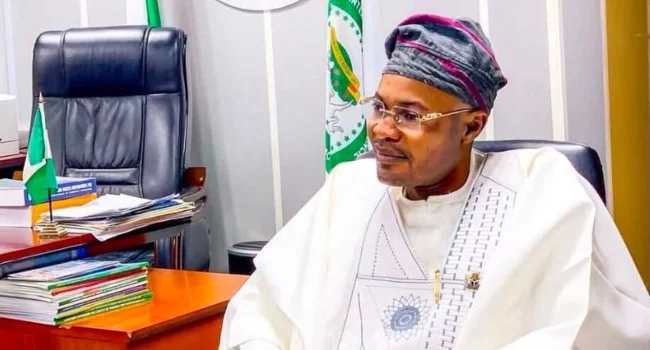
For more than a year, a man calling himself “Prince” Adeniyi Adeyemi Matthew occupied an office on the second floor of the Federal Secretariat Complex in Abuja, held meetings with foreign diplomats, and presented himself as Director-General of a federal body he called the Presidential Foreign Intervention Promotion Council (PFIPC).
In mid-2026, Nigeria’s Presidency publicly disowned him, describing the council as fictitious and Adeyemi as an impostor who had forged government documents to sustain the illusion.
He is now facing an eight-count criminal charge before the Federal High Court in Abuja, and the case remains open, with allegations yet to be tested in court.
| Also known as | Adeyemi Adeniyi Matthew; self-styled “Prince” Adeniyi Adeyemi |
|---|---|
| Nationality | Nigerian |
| Disputed title | Self-declared Director-General, Presidential Foreign Intervention Promotion Council (a body the Nigerian government says was never legally established) |
| Criminal case number | FHC/ABJ/CR/562/2025 |
| Court | Federal High Court, Abuja |
| Presiding judge (criminal case) | Justice Mohammed Umar |
| Status as of September 25, 2026 | In police custody; arraignment scheduled for September 30, 2026 |
According to a statement later issued by the Presidency, Adeyemi’s pattern of claiming positions he did not hold predates the PFIPC affair by nearly a decade.
In November 2016, Nigerian newspapers reported that he had been elected President-General of a body called the World Youth Organisation (WYO) at a conference in New Delhi, India, which he described as an arm of the United Nations.
A contemporaneous report at the time named him as a chartered accountant and a graduate of agronomy from Ladoke Akintola University of Technology (LAUTECH), Ogbomoso, with an accounting qualification from a Canadian university, and said he had won the WYO election with 1,679 votes against 501 for the closest challenger.
The story was carried by several outlets before the United Nations denied that any such organisation existed. The Presidency’s 2026 statement pointed back to this episode as evidence of what it called a documented history of fraudulent misrepresentation.
The News Chronicle separately reported that Adeyemi, who was said to be in his 30s and from Ogbomoso, had twice contested and lost the Student Union Government presidency as a LAUTECH undergraduate before leaving the university in 2015, and that he was known for being photographed alongside prominent public figures.
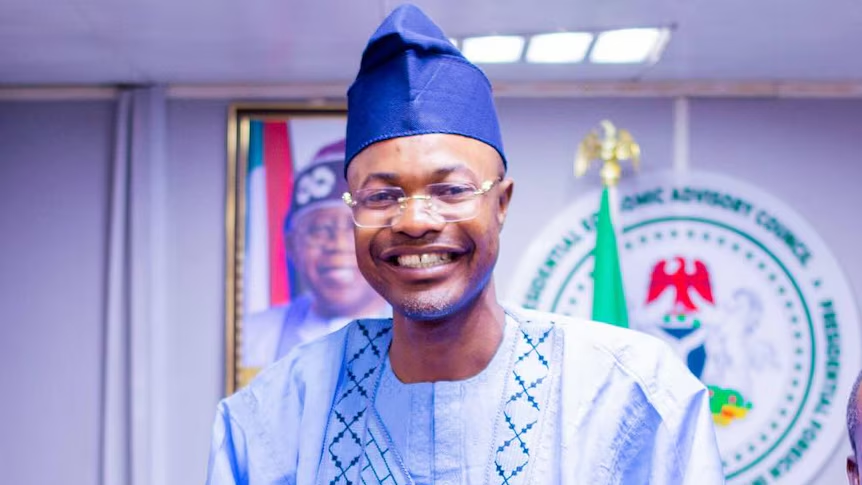
By the mid-2020s, Adeyemi had begun presenting himself as Director-General of the PFIPC, also styled at times as the Presidential Economic Advisory Council (PEAC).
The Presidency later said he secured office space at the Federal Secretariat Complex, Phase III, and used it to host meetings with both foreign diplomats and Nigerian officials while claiming government backing.
Investigators alleged he went as far as requesting a note verbale from Nigeria’s Ministry of Foreign Affairs to the United States embassy, intended to help facilitate visas for people he described as his staff, and that he used forged documents to open a bank account with the Central Bank of Nigeria through the Office of the Accountant-General of the Federation.
The controversy escalated after it emerged that an entity bearing a name matching or close to the PFIPC appeared in the signed 2026 Appropriation Act, with a budget line of roughly ₦1.3 billion (reported at ₦1,302,978,784).
Government officials maintained that no funds were released against that allocation before the scheme was uncovered, though the presence of the line item in the national budget deepened public scrutiny of how the fictitious agency had gone undetected.
The Independent Corrupt Practices and Other Related Offences Commission (ICPC) later reported that Adeyemi told investigators he had financed the operation through private loans rather than public money, including about ₦400 million he said he borrowed from Divine Dopacy Nigeria Limited, a company owned by one Oyekunle Oluwagbemiga, and through a company he had registered, World Entrepreneurship University Limited. Part of that funding, according to the ICPC, went toward organising an event he called the World Investment Summit.
The Office of the Chief of Staff to the President first raised the alarm in a letter dated October 17, 2025, asking the Department of State Services and the Nigeria Police Force to investigate forged appointment letters purportedly issued from the office.
Investigators said the letters carried falsified signatures, reference numbers and seals, and had been used to claim leadership of the PFIPC.
On October 27, 2025, police arrested Adeyemi at the secretariat office he had been operating from in Abuja and searched his residence in Suleja, recovering documents described as exhibits.
On November 5, 2025, the Chief of Staff issued a further written denial, stating that his office had no dealings with Adeyemi or the council he claimed to lead.
Following the investigation, police filed an eight-count charge against Adeyemi and two co-defendants, identified in court papers only as “Femi Surname Unknown” and “Anu Surname Unknown,” before the Federal High Court in Abuja on November 27, 2025. The charges include forgery, criminal conspiracy, impersonation and obtaining by false pretences.
On July 1–2, 2026, the Presidency’s Special Adviser on Information and Strategy, Bayo Onanuga, issued a detailed public statement disowning Adeyemi and the council, which drew wide national attention to the case for the first time.
The United Nations Youth Office also issued a letter, dated July 27, 2026, stating that Adeyemi held no appointment, employment or affiliation of any kind with the office and had never been authorised to represent it, after Nigeria’s Permanent Mission to the UN sought clarification about a separate claim he had made regarding a UN youth position.
| Date | Development |
|---|---|
| November 12, 2016 | Reported to have been declared winner of a “World Youth Organisation” presidency at a conference in New Delhi, a claim later denied by the UN |
| October 17, 2025 | Chief of Staff’s office asks the DSS and police to probe forged appointment letters |
| October 27, 2025 | Adeyemi arrested at the Federal Secretariat office he had been operating from in Abuja |
| November 5, 2025 | Chief of Staff issues a written denial of any dealings with Adeyemi or the PFIPC |
| November 27, 2025 | Police file an eight-count charge (FHC/ABJ/CR/562/2025) against Adeyemi and two others |
| July 1–2, 2026 | Presidency publicly disowns Adeyemi and the PFIPC in a statement by Bayo Onanuga |
| July 14, 2026 | Adeyemi fails to appear for a scheduled court date; Justice Mohammed Umar issues a bench warrant; police say they arrest him in Osun State |
| July 27, 2026 | UN Youth Office issues a letter denying any appointment or affiliation with Adeyemi |
| August 2026 | ICPC submits an interim report to President Tinubu recommending prosecution; a House of Representatives ad hoc committee reports about 58 bank accounts linked to Adeyemi and clears the Chief of Staff of wrongdoing |
| September 3, 2026 | Justice Obiora Egwuatu declines Adeyemi’s bail and medical-treatment requests in a separate rights suit, but orders that he be given unhindered access to his lawyers |
| September 10, 2026 | The rights suit is returned to the court registry for reassignment after a hearing-notice dispute |
| September 30, 2026 | Criminal arraignment before Justice Umar scheduled to proceed |
Adeyemi has remained in police custody since his arrest in July 2026. Separately from the criminal case, his lawyer filed a fundamental rights enforcement suit against the Attorney-General of the Federation, the Inspector-General of Police, the Nigeria Police Force and an Assistant Inspector-General of Police, seeking his release, bail pending trial, access to a doctor of his choice, and an order barring police from questioning him without a lawyer present.
On September 3, 2026, Justice Obiora Egwuatu declined to grant bail or the medical-treatment request at that stage, saying the police and other respondents first needed to be heard, though he ordered that Adeyemi be allowed unhindered access to his lawyers and gave the respondents 72 hours to explain why the remaining requests should not be granted.
An affidavit filed in that suit, from a person identified as Adeyemi’s elder brother, Adeniyi Adebola, said Adeyemi had been unable to personally attend to a commissioner for oaths because he was in detention.
On September 10, 2026, the court returned the rights suit to the registry for reassignment after ruling that proof of service of a hearing notice was not properly established, meaning the bail question in that suit had not been resolved as of the most recent reporting.
President Bola Tinubu asked the ICPC to investigate the affair after the scandal became public. The commission’s interim findings, submitted to the President in August 2026, concluded that Adeyemi was never appointed by the federal government and that the documents used to set up the PFIPC were forged.
A separate House of Representatives ad hoc committee, chaired by Yusuf Gagdi, reported that the council had no legal basis, pointing to forged presidential documents and what it described as a mutilated National Assembly Act among the irregularities.
The committee said it had linked around 58 bank accounts to Adeyemi and identified about a dozen associated fake entities. The same committee cleared the Chief of Staff, Femi Gbajabiamila, of wrongdoing, concluding that the evidence showed he had acted to expose the fake agency rather than support it.
As of September 25, 2026, Adeyemi remains in police custody and has not yet entered a plea.
His criminal arraignment before Justice Umar is scheduled for September 30, 2026, and the separate rights suit over his bail and medical care is pending reassignment.
In television appearances before his arrest, Adeyemi denied wrongdoing, said he preferred an independent panel with international membership to investigate the matter rather than the ICPC, and argued that the council would not have appeared in the federal budget if it did not exist.
He has also said he fears for his safety. None of the allegations against him has been proven in court, and he is entitled to a defence and a fair hearing before any verdict is reached.
Last updated: September 25, 2026
Zeez is the editor and founder of BioOrbit, where he researches and writes biographies of public figures from Nigeria and around the world. With 5 years of experience writing about news, entertainment, sports and politics, Zeez focuses on verified facts, clear sourcing and regular updates. Found an error? Report a correction.