 11
11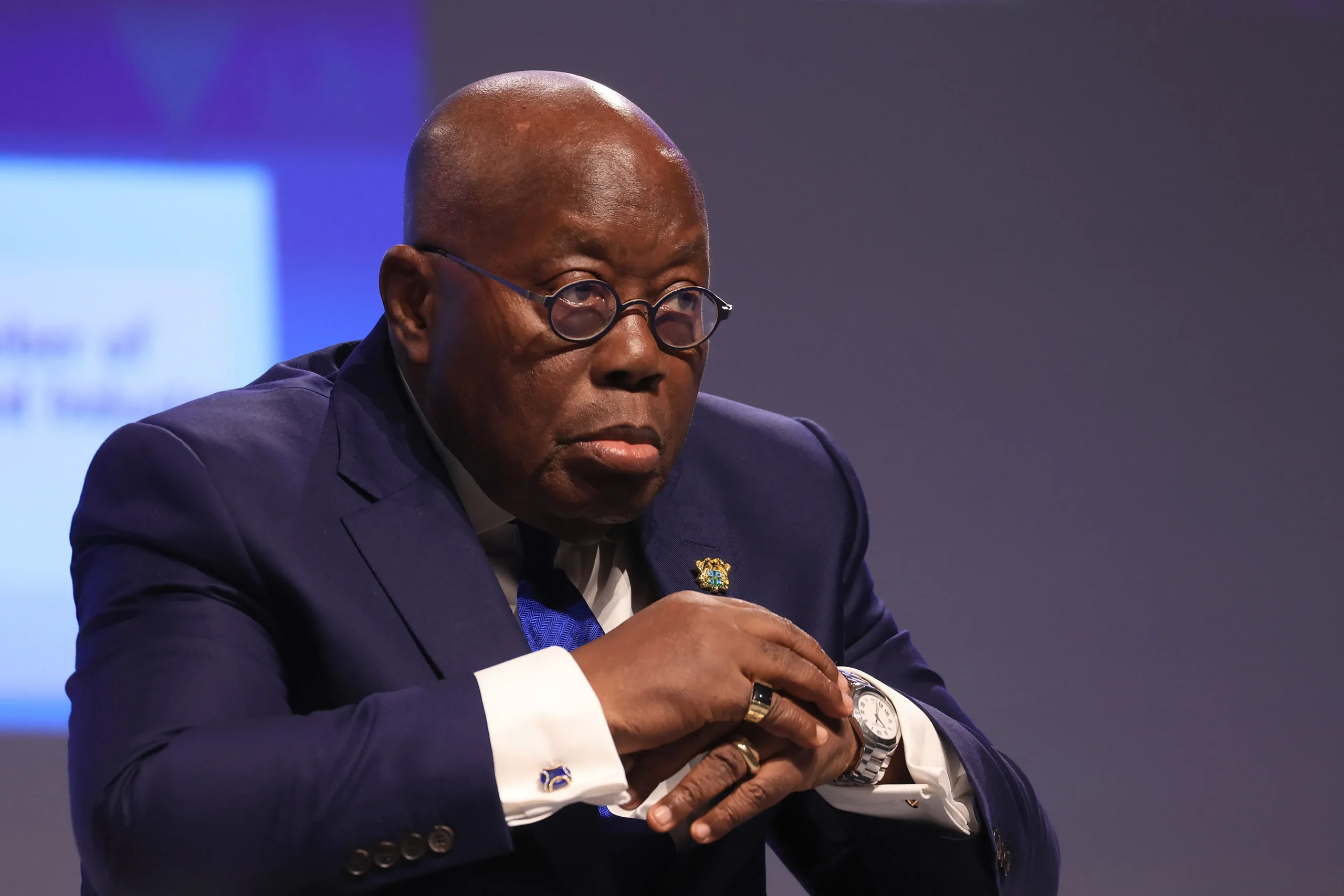
Nana Addo Dankwa Akufo-Addo is one of Ghana’s most consequential political figures of the modern era.
A seasoned lawyer, human rights advocate, and veteran statesman, he served as the President of the Republic of Ghana from January 2017 to January 2025, winning two successive presidential elections in 2016 and 2020.
Known for his eloquence, tenacity, and deep commitment to democratic governance, Akufo-Addo came from one of Ghana’s most distinguished political families and carried that legacy into the highest office in the land.
His administration is remembered for flagship policies such as the Free Senior High School programme, the “Ghana Beyond Aid” vision, and significant infrastructure development, as well as controversies surrounding economic management and fiscal challenges.
| Full Name | Nana Addo Dankwa Akufo-Addo |
| Born | March 29, 1944 |
| Age | 81 years old |
| Birthplace | Swalaba, Accra, Gold Coast (now Ghana) |
| Nationality | Ghanaian |
| Occupation | Lawyer, Politician, Former President |
| Political Party | New Patriotic Party (NPP) |
| Religion | Christianity |
| Parents | Edward Akufo-Addo (father), Adeline Akufo-Addo (mother) |
| Spouse | Rebecca Akufo-Addo (née Griffiths-Randolph) |
| Children | Five children |
| Net Worth | Estimated at several million USD (not officially disclosed) |
Nana Addo Dankwa Akufo-Addo was born on March 29, 1944, in Swalaba, Accra, in what was then the Gold Coast, a British colony that would later gain independence as Ghana. He was born into one of Ghana’s most distinguished and politically influential families. His father, Edward Akufo-Addo, was a prominent lawyer who later became the third Chief Justice of Ghana and subsequently served as Ghana’s ceremonial President from 1970 to 1972. His mother, Adeline Akufo-Addo (née Nana Yeboakua Ofori-Atta), was the daughter of Nana Sir Ofori Atta I, the paramount chief of the Akyem Abuakwa state.
The young Akufo-Addo grew up in an environment steeped in law, politics, and public service. Three of the Big Six the founding fathers of modern Ghana were his blood relatives: J.B. Danquah was his grand-uncle, William Ofori Atta was his uncle, and his own father was among them. His father’s Accra residence effectively served as the headquarters of the United Gold Coast Convention (UGCC), Ghana’s first political party, after its formation in 1947. Growing up in this environment shaped Akufo-Addo’s worldview, imbuing in him a profound sense of history, national identity, and civic duty.
Akufo-Addo began his education at the Government Boys School in Accra, then continued at the Rowe Road School, also in Accra. For his secondary education, he travelled to England, attending Lancing College from 1957 to 1961, where he sat his O-Level and A-Level examinations. He returned briefly to Ghana in 1962 to teach at the Accra Academy before enrolling at the University of Ghana, Legon, in 1964, where he studied Economics and graduated in 1967.
He subsequently returned to the United Kingdom to study law. He trained at the Middle Temple, one of England’s prestigious Inns of Court, and was called to the English Bar in 1971. He was later called to the Ghana Bar in 1975. In between, he also worked briefly for a law firm in Paris, France. In 1979, he co-founded the law firm Akufo-Addo, Prempeh and Company in Ghana, which became a highly regarded legal practice.
Akufo-Addo began his political career in earnest in the 1970s, serving as General Secretary of the People’s Movement for Freedom and Justice, which opposed Ghana’s military rule. He was among the prominent Ghanaians who resisted dictatorial governance and advocated for the restoration of constitutional democracy.
When Ghana transitioned to constitutional democracy under the Fourth Republic, Akufo-Addo ran for and was elected as Member of Parliament for the Abuakwa North constituency in the Eastern Region in 1996. He was subsequently appointed Attorney General and Minister of Justice under President John Agyekum Kufuor, serving from 2001 to 2003. He later served as Minister for Foreign Affairs from 2003 to 2007, a role in which he burnished Ghana’s diplomatic reputation on the African continent and internationally.
He made his first bid for the presidency in 2008, narrowly losing to John Evans Atta Mills of the NDC in a keenly contested runoff election. He ran again in 2012 and lost to John Dramani Mahama. His defeat in 2012 led to a historic election petition before the Supreme Court, which ultimately upheld the election results. His third and successful presidential bid came in 2016, when he defeated incumbent President John Mahama decisively, polling over 53% of the vote. He was inaugurated as Ghana’s President on January 7, 2017.
His administration introduced the Free Senior High School (Free SHS) policy in September 2017, making secondary education free and compulsory for all Ghanaians one of the most celebrated social interventions in Ghana’s post-independence history. He was re-elected in December 2020, defeating former President John Mahama again, though by a much slimmer margin. His second term was marked by the economic fallout from the COVID-19 pandemic, rising public debt, and a painful IMF bailout programme, which drew significant domestic criticism. He handed power to John Mahama in January 2025 following the NDC’s electoral victory in December 2024.
Nana Akufo-Addo has been active on social media, using platforms to communicate government policies and engage with citizens during his presidency.
Akufo-Addo is married to Rebecca Akufo-Addo (née Griffiths-Randolph), the daughter of Justice J.H. Griffiths-Randolph, who served as Speaker of Ghana’s Parliament during the Third Republic. The couple met and married, and together they have five children. They also have five grandchildren.
Akufo-Addo is known as a devout Christian and a committed family man. Despite the demands of political life, he has maintained a reputation for personal discipline. During his presidency, he faced persistent controversies including accusations of nepotism several relatives and close associates held key government positions as well as economic mismanagement allegations. His administration also faced scrutiny over galamsey (illegal mining), corruption within state institutions, and the controversial E-Levy. Despite these controversies, he remains a highly respected figure in Ghanaian political history.
Nana Akufo-Addo’s net worth has not been officially disclosed, but as a senior lawyer with decades of private practice experience and a member of one of Ghana’s wealthiest and most influential families, his personal wealth is considered substantial. His family connections to Databank Financial Services and other major Ghanaian businesses, combined with his long career in public service, form the backdrop to his financial standing. While specific figures have never been confirmed, various media estimates place his net worth in the range of several million US dollars.
Nana Akufo-Addo is a Ghanaian lawyer and politician who served as the President of Ghana from January 2017 to January 2025.
He was born on March 29, 1944, in Accra, Ghana.
He is best known for introducing the Free Senior High School (Free SHS) policy in Ghana and for his “Ghana Beyond Aid” vision.
His father is Edward Akufo-Addo, a former Chief Justice and ceremonial President of Ghana, and his mother is the late Adeline Akufo-Addo, daughter of Nana Sir Ofori Atta I.
He ran for president three times: in 2008 (lost), 2012 (lost), and 2016 (won). He was re-elected in 2020 and served until January 2025.
Nana Addo Dankwa Akufo-Addo’s life is a remarkable story of persistence, patriotism, and principled leadership. Born into political royalty, he did not inherit power but earned it through decades of public service, professional excellence, and an unshakeable belief in Ghana’s potential. As President, he left behind a complex legacy celebrated for expanding access to education and restoring democratic norms, while also criticised for economic challenges and governance controversies. Regardless of where one stands politically, Akufo-Addo’s place in Ghana’s history as a lawyer, human rights advocate, and two-term president is secure, and his influence on the trajectory of Ghanaian democracy will be felt for generations to come.